
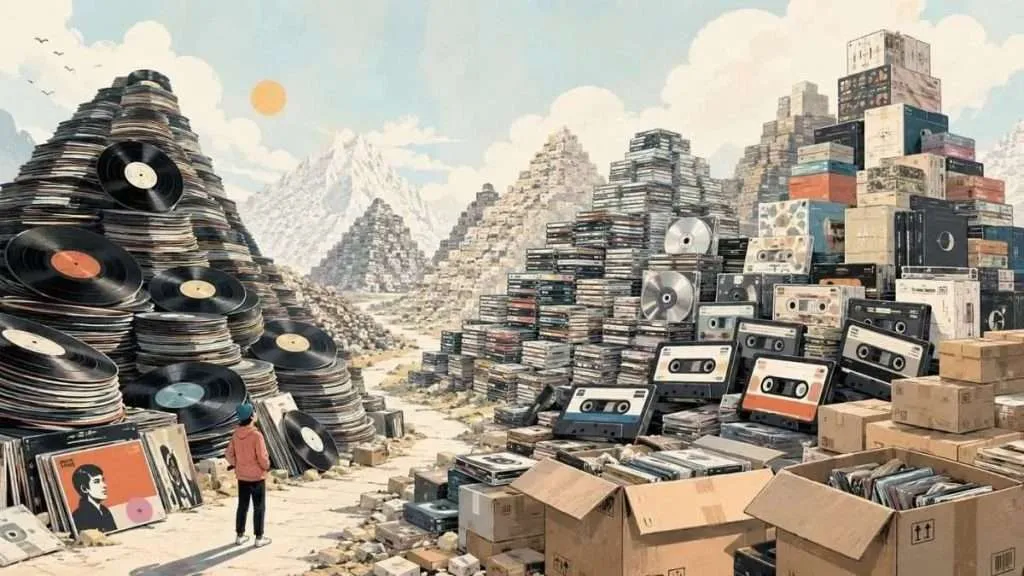
Have you seen the boxes of CDs in my garage (that floods)?
Streaming won the listening war. Physical media found another job: making money.
Apparently physical media is back, which is wonderful news for anyone who has spent the past twenty years wondering what to do with all those shelves.
Vinyl has been back for so long that we should probably stop calling it a “comeback”. CDs, which we ceremonially buried sometime around the arrival of the iPod, are showing signs of life again. Cassettes have crawled out of the glove compartment and are somehow being sold to people whose parents may never have owned a cassette deck. Somewhere, I assume, somebody is preparing the triumphant return of the MiniDisc.
I should disclose my bias before we go any further. I hate physical product.
I have lived through enough versions of the music business to have accumulated boxes of unsold discs from different eras of my career. Some people look at a carton of old CDs and see their artistic legacy. I see inventory. Heavy inventory. Inventory that has moved with me, survived career changes and managed to prove one of the great selling points of physical media: unlike digital music, the damn stuff really does last forever. Now they are dusty boxes in my garage (that floods).
So when I read another headline announcing that “physical media is back,” my first impulse is not to run to a pressing plant. My first impulse is to ask exactly what back means.
It turns out that something very real is happening. It is just not the thing the nostalgic headlines suggest and the vindication that all those “old schoolers” are hoping for.
Streaming Did Not Lose
Let us begin by killing the most ridiculous version of this story. People are not abandoning Spotify, Apple Music and YouTube so they can return to sitting in front of giant stereo systems alphabetizing their record collections.
Streaming won. Like, really won.
In the United States, streaming generated about $9.5 billion in wholesale recorded-music revenue in 2025. All physical formats combined generated about $1.38 billion. Vinyl had a very good year, surpassing $1 billion in U.S. revenue, but streaming remains the basic infrastructure of the recorded-music business.
Globally, music streaming is still growing. Luminate says on-demand audio streams increased another 9.8% during the first half of 2026. Whatever else is happening, hundreds of millions of people did not wake up one morning and decide that instantaneous access to virtually every record ever made was inconvenient.
The physical revival is therefore not replacing streaming. It is growing on top of streaming.
This distinction changes everything.
Streaming is exceptionally good at giving listeners access to music. What it is considerably less efficient at doing is extracting a meaningful amount of money from one particular fan’s love for one particular artist. A person can listen to your album repeatedly for a month while paying the same subscription fee whether she listens to you, Taylor Swift or recordings of rain hitting a tent.
Physical merchandise changes the transaction completely. The fan is no longer renting access to everything. The fan is choosing to give money specifically to you.
Suddenly that piece of plastic starts looking a lot less stupid.
I still think it is stupid. I just understand the business model.
The Los Campesinos! Math Should Get Every Artist’s Attention
The Welsh indie band Los Campesinos! has provided one of the clearest real-world demonstrations I have seen of the difference between streaming economics and direct fan spending.
The band owns the rights to its 2024 album All Hell, which makes its numbers particularly useful because there is no mystery about a record company sitting between the revenue and the musicians. During the album’s first year, tracks from All Hell accumulated roughly 9.3 million streams across digital platforms and generated £31,940.29. Spotify accounted for almost 75% of those streams and roughly £20,429 of the revenue.
Nine million streams sounds impressive because nine million of almost anything sounds impressive. Then you remember that Los Campesinos! is a seven-person band with an actual business to operate.
Now look at the merch table.
The band also published detailed accounts from an 11-show U.S. tour. Merchandise sales totaled $111,978, almost 89% as much as the band received in performance fees for the shows themselves. After manufacturing, credit-card fees, point-of-sale costs and shipping, Los Campesinos! calculated approximately £40,337 in merchandise profit.
That means the profit from merchandise on eleven shows exceeded the revenue generated by more than nine million streams of All Hell over an entire year.
These are not directly equivalent accounting periods, and the band is unusually transparent, established and supported by an intensely loyal audience. Los Campesinos! explicitly warns that newer bands should not assume they can reproduce its merchandise results. But the basic economic lesson is impossible to miss.
A stream is consumption.
A purchase is commerce.
Dear reader — those are not the same thing.
On another tour, the band reported selling 1,474 shirts and more than 500 LPs, producing £69,576 in merchandise sales. Fans were not simply buying cotton and grooved plastic. The band described many of those purchases as a way for longtime listeners to provide additional financial support.
That may be the real physical-media revival hiding underneath all the retro photographs of turntables.
Fans want a way to pay the artist they care about.
Even Spotify Knows Streaming Is Only Part of The Career
This is where the argument needs to be fair.
Spotify is not paying nothing. The company says it paid more than $11 billion to the music industry in 2025, and more than 81,000 artists generated at least $10,000 in Spotify royalties. More than 13,800 generated at least $100,000. Those are meaningful numbers, and the idea that streaming produces no careers is simply false.
To be clear, I do not like Spotify and I do not subscribe to it.
Spotify also points out something important when defending its economics: streaming audiences can generate income elsewhere through concerts, merchandise and other activities. In other words, even Spotify’s argument for the value of streaming extends beyond the stream itself.
That is the modern artist economy in one sentence, even if Spotify did not mean it quite the way I do.
The stream finds the fan.
Then you need to sell the fan something.
Welcome back, compact disc.
Taylor Swift Did Not Sell 1.2 million Turntable Experiences
At the superstar level, physical media has evolved into something even more sophisticated. It has become a tool for monetizing superfandom.
Taylor Swift’s The Life of a Showgirl sold an astonishing 1.2 million vinyl copies in the United States during its first week in 2025. Numerous exclusive variants contributed to the record, and Luminate eventually counted 27 physical editions connected with the campaign.
Twenty-seven! There is some bedroom with all 27 versions stacked-up and an annoyed parent who got to pay for them.
At that point we are no longer discussing the functional requirement to own a copy of the album.
We are discussing collecting.
Different artwork, different colors, different exclusives and different configurations turn one album into a series of objects. The recording remains the center of the universe, but the commercial proposition becomes much broader: Which version do you own? How many versions do you own? Do you have the limited one?
This is an extremely effective business model when Taylor Swift does it because Taylor Swift has millions of fans predisposed to care about distinctions between editions.
It becomes considerably less convincing when an independent artist with 1,700 monthly listeners decides the market has been waiting for translucent-purple vinyl.
Scale matters.
Fan intensity matters even more.
K-Pop Figured This Out Years Ago
If you really want to understand why the CD is apparently returning from the dead, do not begin with the CD player.
Begin with K-pop.
Luminate found that seven of America’s ten best-selling CDs in 2025 were K-pop releases. ENHYPEN’s DESIRE: UNLEASH, for example, came in seven member-specific versions with different artwork, photobooks and collectibles. Luminate found that 27% of U.S. K-pop fans had purchased a CD during 2025, versus 19% of music listeners overall, and a substantial portion of those K-pop CD buyers had purchased multiple discs.
The brilliance of the model is obvious once you stop thinking about a CD as merely a device containing 74 minutes of digital audio.
The music is available everywhere already.
The product contains the fandom.
Photocards, photographs, packaging, different members, limited inserts and alternate editions transform an obsolete delivery format into a collectible object. The CD did not defeat streaming. It escaped from the competition altogether.
You might stream the album on your phone while the physical copy sits unopened on your shelf.
From the standpoint of the artist’s bank account, this is not a design flaw.
And Now CDs Really Are Showing Signs of Life
The recent headlines about CDs are not completely invented, although they deserve some context.
RIAA figures show U.S. CD unit sales actually fell 11.6% during full-year 2025. If somebody told you the great CD revolution had already arrived last year, the numbers did not cooperate.
Then something interesting happened. During the first half of 2026, Luminate says U.S. CD sales jumped 16% to 16.3 million units. K-pop contributed heavily, but even after removing K-pop, CD sales were still up 6.7%. Vinyl, meanwhile, increased only 2.4%.
Just this month, British retailer John Lewis reported that searches for CD players had risen 96% since July, with some models selling out. HMV has also reported strengthening CD demand, particularly around major releases and exclusives.
This could become a durable trend, or it could be one more delightful retro hiccup. I am not yet ready to start investing in jewel-case futures.
But the economics make sense. CDs are considerably cheaper than vinyl, easier to manufacture, easier to ship, harder to warp and much less likely to turn a normal apartment into a structural engineering problem.
If young fans want physical ownership but a $40 record has become ridiculous, the $12 or $15 CD suddenly looks rather sensible.
I never expected to write that sentence again. I feel dirty.
Cassettes Are Back, Provided We Use the Word “Back” Very Cautiously
Then we arrive at cassettes.
The Official Charts Company says cassette sales in Britain rose 53% in 2025, reaching 164,000 units. Robbie Williams sold 21,400 cassette copies of the Better Man soundtrack, and cassettes accounted for almost half of its 43,000 combined chart sales during its physical-release push.
That is fascinating.
It is also 164,000 cassettes in an entire country.
For comparison, Britain sold about 7.5 million vinyl albums during the same year. Cassettes can therefore be “booming” while remaining a microscopic part of music consumption. Both statements are true.
What cassettes can do extremely well is create a limited, inexpensive artifact and add physical units during a release campaign. In Britain, physical product still matters enormously to the album chart: 34 of 43 different №1 albums in 2025 reached the top in weeks when the majority of their chart units came from physical sales. Twenty-five of those №1 campaigns included cassette, CD and vinyl versions.
So yes, the cassette is back.
It is back partly because it is cute, cheap, nostalgic and collectible, and partly because the music industry discovered that an object last considered technologically impressive during the Reagan administration can still help move a chart position.
I admire the hustle.
Billie Eilish Said the Quiet Part Out Loud
There is, of course, a point where clever monetization becomes absurd.
Billie Eilish caused a small industry explosion in 2024 when she criticized artists releasing huge numbers of vinyl variants, saying, “I can’t even express to you how wasteful it is.” Her larger complaint was explicit: multiple packages with small differences encourage fans to keep buying the same album, inflating both revenue and chart performance.
Her mother, Maggie Baird, made the more uncomfortable point. If chart systems reward this behavior, artists who want to compete are strongly incentivized to participate.
That is the part of the physical revival nobody should romanticize.
Some of this is love. Some of it is collecting. Some of it is artists desperately trying to replace income the recorded-music business used to produce in other ways. And some of it is very sophisticated revenue extraction from the most devoted people in the room.
These things can all be true simultaneously.
Bandcamp Is the Less Glamorous Version of The Same Idea
The superstar variant game attracts headlines, but the independent version is probably more important.
Bandcamp says fans have paid artists and labels $1.78 billion through the platform. During the past year alone, customers bought 1.6 million vinyl records, 850,000 CDs, 250,000 cassettes and tens of thousands of other physical products. On an average transaction, about 82% of the money goes to the artist or label after Bandcamp’s share and processing costs.
Bandcamp says merchandise now represents roughly half of sales on the platform. That statistic matters because less than 20% of releases on Bandcamp even have a physical product attached, meaning the projects that do offer merchandise generate an outsized share of revenue.
That is what direct-to-fan economics look like.
A fan streaming an artist 100 times is valuable.
A fan who decides, I want to give this person $30, is a different category of valuable.
The record, cassette, shirt, signed print or limited object provides a socially acceptable reason for that transaction to occur. Instead of sending the artist thirty bucks and writing “please continue making music” in the memo line, the fan gets an object.
Everybody gets to preserve some dignity.
Gen Z Likes “Real” Things, But Let’s Not Get Carried Away
There is also growing evidence that younger listeners genuinely like physical media.
The Vinyl Alliance surveyed young vinyl fans and found that 76% cited owning a physical copy of music as part of the appeal, while 62% cited supporting a favorite artist. Half of Gen Z vinyl listeners described records as providing a break from digital life.
This makes intuitive sense.
If you grew up with infinite digital access, a record is strange.
It has edges.
It has weight.
It occupies space whether you are interested in it today or not.
It does not send you notifications.
You cannot swipe left on side two.
Maybe older generations see obsolete technology while younger people see something wonderfully inconvenient.
But there is another number in the Vinyl Alliance research that I find much more important. Twenty-nine percent of Gen Z vinyl fans said higher prices had already caused them to reduce or stop buying records, while 36% said better playback equipment was too expensive. Nearly half still considered vinyl expensive but worth buying because it was something they would cherish.
There is the ceiling.
People like real things.
They do not possess imaginary money.
Vinyl May Have Priced Itself into Luxury
Vinyl’s growth has been remarkable, but there are hints that the business is entering a more mature — and less euphoric — phase.
U.S. vinyl units grew 7.9% in 2025 while revenue grew 9.3%, meaning rising value per unit contributed to revenue growth. In the first half of 2026, unit growth slowed to just 2.4%.
A $40 or $50 LP is no longer an impulse purchase for most people.
Neither is a $150 deluxe box.
Once physical media becomes a luxury good, the customer becomes more selective. The object has to justify its existence.
The hardware story provides another reality check. The broader global home-audio market contracted 7.7% in both volume and value during 2024. Traditional hi-fi systems were hit even harder, falling nearly 15%, and Futuresource expects continued pressure on that category even while parts of home audio stabilize.
That does not mean turntables are disappearing. It means buying vinyl records does not automatically mean somebody is building the stereo system we would have associated with record collecting forty years ago.
Sometimes the record is the stereo system.
It is the object itself.
I Have Seen the Other Side of This Business
This is the section of the physical-media revival that artists should take personally.
Manufacturing is intoxicating because manufacturing feels like progress.
You have an album. You approve the artwork. Then boxes arrive.
Look at that. A product. You hold your work in your hands. It is an emotional connection for artists. What started as an idea is now physical.
Unfortunately, the pressing plant does not require proof that anyone actually wants it.
This is how artists end up with 800 CDs in a closet or my garage (that floods).
Physical inventory contains a peculiar psychological trap because per-unit costs frequently encourage you to manufacture more than you need. Five hundred units seem expensive, but one thousand units make the unit price look much better. Suddenly you have “saved” money by spending more money on twice as many objects.
Brilliant. This is the economics of wedding invitations.
I have been through enough ups and downs in this business to know what happens next. Years pass, platforms change, addresses change, and somehow those boxes remain perfectly healthy.
Physical media’s greatest consumer virtue — permanence — is occasionally the artist’s nightmare.
Even superstars can distort the manufacturing ecosystem. Before Adele released 30 in 2021, more than 500,000 vinyl copies were reportedly manufactured while an already strained pressing industry struggled with extraordinary demand. The album sold enormous numbers, but the episode became a warning about what happens when physical-media enthusiasm collides with limited production capacity and giant advance orders.
For an independent artist, the stakes are simpler.
Unsold streaming inventory costs nothing.
Unsold vinyl can require a storage unit.
So, What Is Physical Media Actually For?
This is where I have changed my thinking slightly, even if I still do not want another box of CDs anywhere near my garage (that floods).
Physical media is not coming back as the primary way people listen to music.
That war is over.
Physical media has come back as a premium layer of fandom.
The stream says, “I listen to you.”
The physical purchase can say, “I support you.”
It can also say, “I collect you,” “I was there,” “This album is part of who I am,” or simply, “I want something with your name on it that cannot disappear because a licensing deal expired.”
That is why K-pop packaging works. It is why Taylor Swift variants work. It is why bands can generate real money at a merch table even while millions of streams produce relatively modest income. It is why Bandcamp can sell hundreds of thousands of CDs and cassettes in an era when nobody actually needs a CD or cassette to hear anything.
The object has stopped competing primarily as a delivery system.
It is competing as an artifact.
That is a much better business.
The Artist Does Not Need a Warehouse. The Fan Needs a Reason.
This is where I think independent musicians should ignore almost everything about the superstar physical-media strategy.
Do not make twenty-seven versions.
Do not manufacture a thousand units because the price per unit is attractive.
Do not press vinyl because you read an article saying vinyl is hot.
Do not manufacture cassettes because apparently twenty-year-olds have decided that rewinding tape with a pencil is charming.
Make something because you know who wants it.
Better yet, know how many people want it before you make it.
Take preorders. Make limited runs. Sign them. Number them. Add artwork that matters. Add photographs, liner notes, scores, essays, alternate mixes or something the streaming version cannot possibly provide. Give the object a reason to exist beyond having twelve digital files trapped inside it.
The future of physical music is probably not more inventory.
It is better artifacts.
That distinction matters because streaming solved a problem physical media can never solve as efficiently. It made music universally accessible. I can hear almost anything, anywhere, immediately, without devoting half my apartment to shelving.
I am extremely grateful for this.
But streaming created another problem in the process. It separated listening from buying so completely that millions of people can deeply love an artist without ever conducting a meaningful financial transaction directly with that artist.
Physical product slipped back through that opening.
The strange little miracle is not that vinyl survived, CDs are flickering back to life or cassettes somehow escaped the landfill. The miracle is that after twenty years of being told that nobody would ever pay for recorded music again, fans keep finding ways to prove that they will.
They just need a reason.
So yes, physical media is back.
Sort of.
It is smaller, more expensive, more collectible, more strategically manufactured and far less necessary than it used to be. It occasionally functions as music, occasionally as merchandise and occasionally as a $40 piece of colored plastic purchased by somebody who will spend the evening listening to the exact same album on Spotify.
That may sound ridiculous.
Economically, it makes perfect sense.
The stream is how the fan hears you.
The physical object is one of the ways the fan tells you that hearing you mattered…


Leave a Reply
You must be logged in to post a comment.